Research
I build learning systems shaped by biological constraints—developmental curricula, active sensing, recurrent computation, and continual adaptation—and validate them against behavior and neural measurements.
Active perception and world modeling
Sequence model interpretability
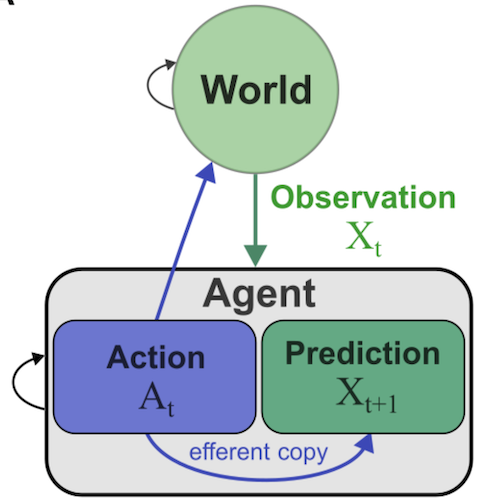
Predicting the next input encodes relational structure amongst the inputs: a RNN path integrates and binds the input tokens to their absolute locations in 2D scenes, in-context.
Scene representation
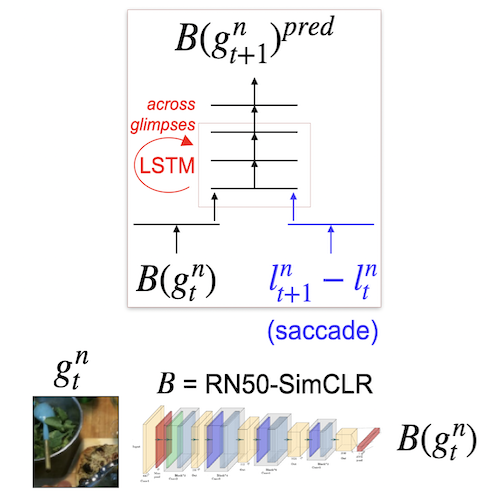
Predicting the next glimpse features (given the saccade) coaxes a network to encode co-occurrence and spatial arrangement in a visual-cortex-aligned scene representation.
Controlling attention
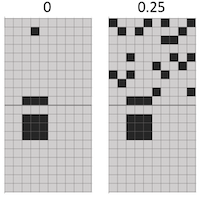
In cluttered object tracking with RL, an agent learns an explicit encoding of attentional state (an “attention schema”), most useful when attention cannot be inferred from the stimulus.
Feedback and recurrent computation
Representational dynamics in RCNNs
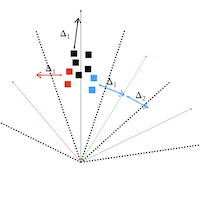
The feedforward sweep instantiates a representational arrangement that dovetails with a recurrence-induced “equal movement” prior, enabling corrected classifications.
Decluttering due to recurrence
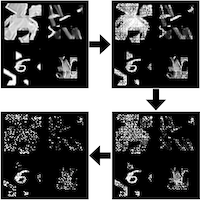
Recurrent flow carries category-orthogonal feature information (e.g., location) used iteratively to constrain subsequent category inference.
Characterizing perception
Ventral stream organization

Animacy organization is not fully driven by visual-feature differences; it also depends on inferred factors like agency quantified behaviorally.
Priors in perceptual report

In a Sperling-like task, people report either occasionally-present or absent inverted letters as upright to the same extent => expectation-driven illusions may be post-perceptual, not p-conscious.
Developmental constraints on learning
Infant visual diet
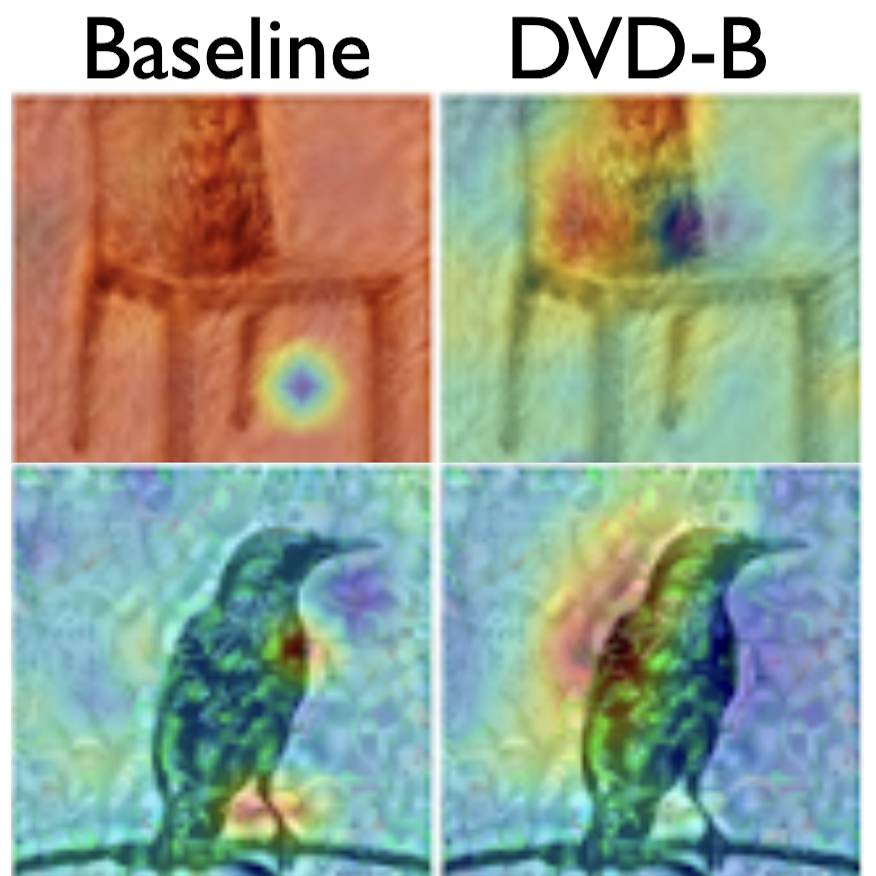
Inspired by the Adaptive Initial Degradation hypothesis, ANNs trained with a graded coarse-to-fine image diet produce strong shape-biased, plus distortion/adversarial robust classification behavior.
Adaptation and cognitive flexibility
Rule inference in NNs
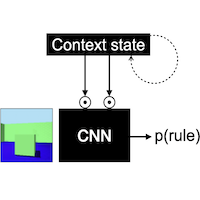
Inspired by Hummos, we built an image-based Wisconsin Card Sorting Task variant and found behavior suggesting sparks of cognitive flexibility: compositional rule inference in activity space.
Continual learning and drift
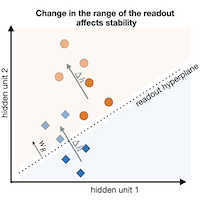
Readout misalignment due to learning-induced drift is a core continual-learning problem. Constraining drift to the readout null-space helps networks stay both stable and plastic.
Attention, search, and selection in scenes
Modulation as routing
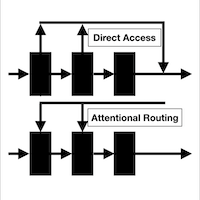
Attentional routing can push task-relevant information through the network as effectively as “direct access,” challenging the necessity of direct access for explaining behavior.
Task-dependence of visual representations
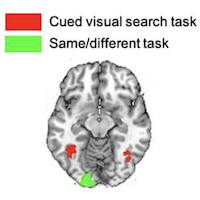
The relation of multi-object display processing to isolated-object representations is task-dependent: same/different relates to earlier; object search, to later representations in MEG/fMRI.
Characterising search templates
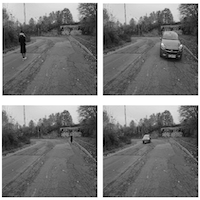
Search templates encode identity and size; size is inferred from location in scenes, and is entangled with identity in the template.
Implicitly learning distractor co-occurrence
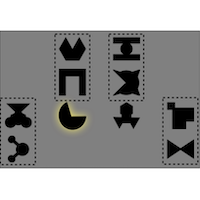
Increased search efficiency amongst co-occurring distractors likely reflects faster/more accurate rejection of a distractor’s partner as a possible target.
High-level feature-based attention
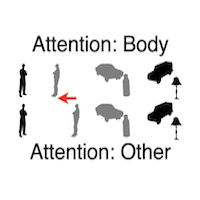
Feature-based attention modulates fMRI representations of body silhouettes presented in task-irrelevant locations in high-level visual cortex.
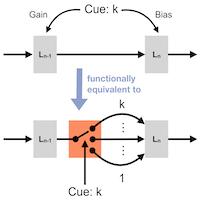
Attentional modulation in NNs
Scene context
Scene co-variation biases categorization, but across 4 experiments we found no evidence that task-irrelevant scenes boost sensitivity for detecting co-varying objects.
Engineering computational systems
Brain ↔ language interface

fMRI responses to natural scenes condition word generation in a Transformer, enabling flexible readout of semantic properties like object class and numerosity.
NLP / graph search
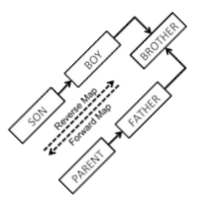
Reverse dictionary via n-hop reverse search on a definition graph. Matched then-SOTA on ~3k lexicon; didn't scale well to ~80k.
SNN control
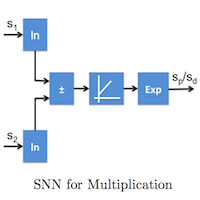
Engineered SNN modules for polynomial transformations on spike trains. Temporal lag hinders SNN-translation of symbolic forward model for velocity–waypoint navigation.